
The Gopher Problem
Jul 06, 2026
What a California "pest" taught me about disturbance, feedback loops, and reading living systems
If you've gardened in Southern California for very long, you've probably lost something to a gopher.
Maybe it was a tomato that suddenly wilted for no obvious reason. Maybe a squash or melon vine that looked perfectly healthy one day and completely collapsed the next. Maybe it was a young fruit tree that you'd spent years watering and caring for, only to find it leaning over because most of its roots had disappeared underground.
I've lost hundreds of trees and shrubs over the years including figs, bananas, papayas, ice cream bean trees, and many other fruit trees this way. Over the years I've also discovered they'll happily eat plants that many gardeners assume are safe like garlic and onions. Apparently this year they seem to prefer red onions over yellow. Hardy perennials like agave are also not immune to the effects of these rodents.
These types of losses are real. Anyone who has spent years establishing a food forest or tending a vegetable garden knows the frustration of watching months or even years of work disappear because of an animal you rarely even see.
Nothing in this article is meant to minimize that frustration. Instead, I'd like to describe an observation that complicated my own understanding of gophers.
The observation that changed the question
Around our house is an area that was heavily compacted during construction. Planting there wasn't simply difficult. Some of the holes required digging bars, picks, and heavy tools because the soil had become almost brick-like. Even after adding compost and deep mulch, most of the roots remained close to the surface. I assumed biology would eventually begin rebuilding the soil, but I also knew that process might take years or even decades without significant mechanical intervention as the soil is incredibly compacted.
Then the gophers arrived. At first, nothing surprising happened. They started eating a few plants. We lost a kangaroo paw, then a Santa Barbara daisy, and a couple of aloes all of which had been growing steadily for more than a year.
Then I noticed something unexpected. While watering one afternoon, the water suddenly disappeared into a fresh gopher tunnel. I left the hose running for quite a while, expecting to eventually see the water emerge somewhere downhill. It never did.
The tunnel itself wasn't particularly deep. The opening appeared only a few inches below the surface, perhaps two to six inches. Whether it connected to a much deeper network I don't know.
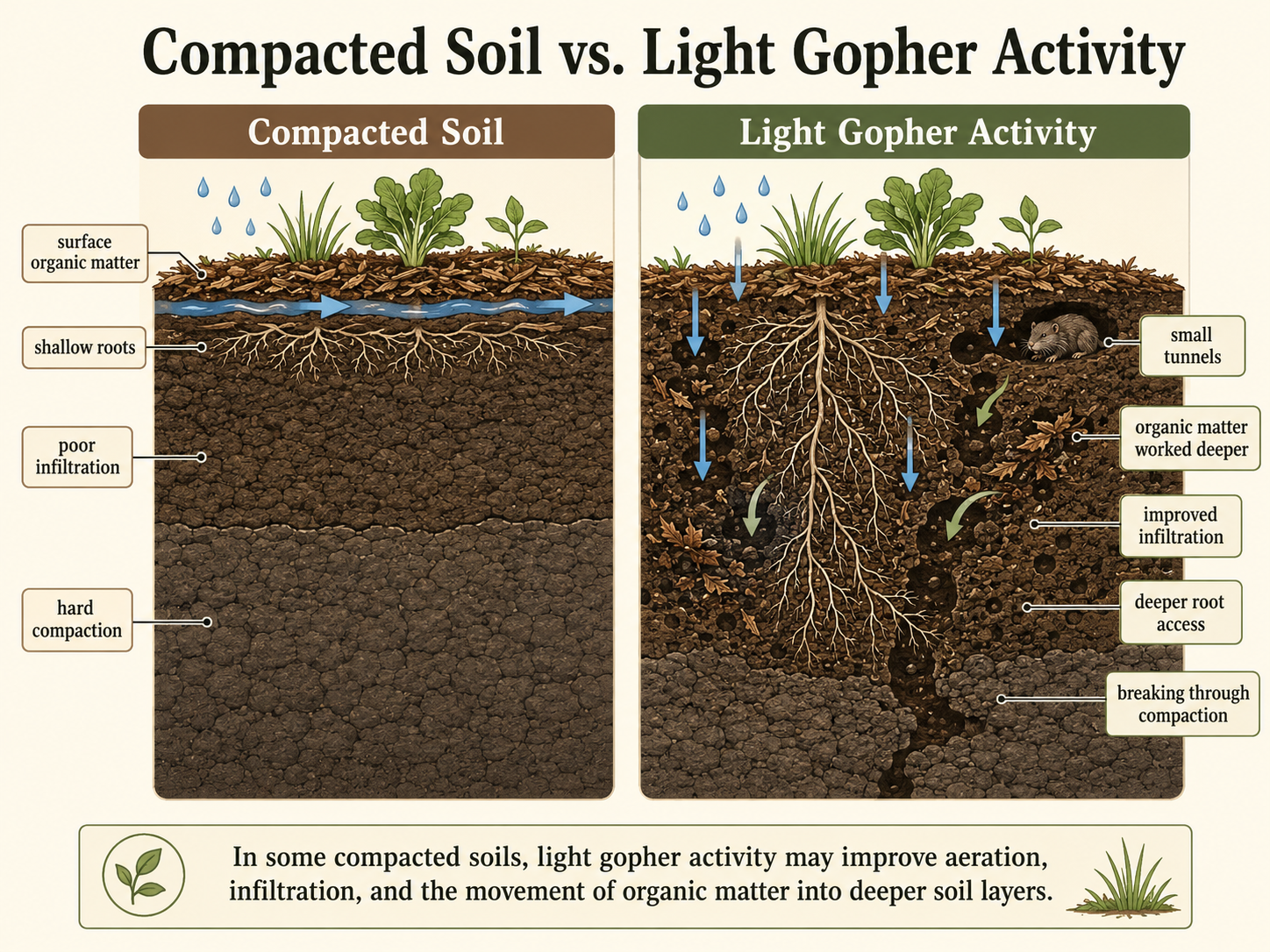
But what struck me wasn't simply where the water went. It was what the gopher had done to soil that I had barely been able to penetrate myself. Around those tunnels I could suddenly dig with my bare hands in ground that had previously required picks and digging bars. I also began noticing organic matter that had been worked much deeper into the soil profile than I would have expected from surface mulching alone.
I still don’t know exactly where that water ended up. But for the first time, I began wondering whether the gopher was doing some of the very work I had been hoping biology would eventually accomplish on its own. It was breaking through hard compaction, opening small passages for air and water, and working compost and organic matter down into the soil far deeper than it would have moved from the surface alone. The action was not unlike the effects of worms albeit at a larger scale and if worms could eat whole plants faster than the plant could regenerate.
That observation didn't suddenly make me like gophers. But it did make me stop and ask whether I was asking the wrong question.
The wrong question
The question most of us ask is simple. Are gophers good or bad?
It feels practical. But I think it's the wrong question.
Living systems rarely divide neatly into beneficial organisms and harmful organisms. An organism can perform several ecological functions simultaneously. Some of those functions may benefit the larger ecosystem. Some may directly conflict with our own goals. Those two things can both be true.
The better question might be this: What role is this organism playing, and how have the relationships around it changed?
That shifts our attention away from judging the animal and toward understanding the system.
Seeing gophers differently
Ecologists often describe pocket gophers as ecosystem engineers because they physically change the environments they inhabit. Every tunnel they dig moves soil. They mix mineral soil with organic matter. They create spaces where air and water can move. They create habitat for microorganisms and other animals. They also feed owls, hawks, snakes, coyotes, bobcats, weasels, and many other predators.
None of that changes the fact that they also eat roots.
The point isn't that gophers are secretly beneficial. It's that they perform multiple functions at the same time. The question is whether those functions are helping or hurting the particular landscape we're trying to create.
Context changes everything
A vegetable garden is very different from a compacted construction site. A young orchard is different from a water-harvesting earthwork. The same tunneling behavior can have very different consequences depending on where it occurs.
In a vegetable bed, it can destroy crops. Around a young fruit tree, it can erase years of growth. I've also seen gopher tunnels undermine water-harvesting earthworks. By creating underground pathways through an embankment, they can concentrate water into small channels that eventually cause piping, erosion, and even catastrophic failure.
Yet in the compacted soils around our home, that same tunneling appeared to be creating pathways for water, air, and organic matter where almost none previously existed.
The behavior hadn't changed. The context had. That realization felt important.
A different way of thinking
One of the principles often repeated in permaculture is that the problem is the solution. Like many design principles, it's easy to repeat and much harder to understand. It doesn't mean every problem is secretly good. It means every problem may be revealing an ecological function that we're overlooking.
The challenge isn't to romanticize the problem. It's to understand the function.
That led me to a strange question I never thought I'd ask. Under what circumstances would I actually want more gophers?
Not in my vegetable beds. Not beneath young fruit trees. Certainly not inside water-harvesting earthworks. But perhaps in severely compacted soils. Perhaps there are places where moderate gopher activity provides services that would otherwise require machinery or many years of natural recovery.
I don't know. And that's okay. The question itself changes how I look at the landscape.
Nutrient cycling
Ecologists, and many of us in permaculture, use the phrase nutrient cycling to describe the continual movement of nutrients through living systems. Plants draw nutrients from the soil. Animals eat plants. Predators eat animals. When organisms die, fungi, bacteria, insects, and countless other decomposers gradually return those nutrients to the soil where they become available for the next generation of life.
Over time, this continual cycling is one of the processes that creates the rich, dark, biologically active soils that gardeners and farmers value so highly. Nothing is truly wasted. The nutrients simply keep moving.
When a gopher eats one of my fruit trees, it's participating in that cycle. The frustration is that it's cycling nutrients through a plant I was hoping to harvest. Understanding that doesn't erase the loss. It simply helps me see that the loss is part of a much larger process.
We are part of the feedback loop
Another realization slowly emerged. The landscape I was observing wasn't simply a natural ecosystem. It was one I had helped create.
We irrigate. We concentrate food into orchards and vegetable gardens. We fragment habitat. We often reduce the predator populations that once helped regulate animals like gophers.
None of those decisions are inherently wrong. But together they create a different set of relationships than the ones that shaped California's landscapes for thousands of years.
The question isn't whether humans belong in living systems. We already do. The question is how we participate.
Seeing gophers as a sector
One of the ideas we teach in permaculture is that every site is influenced by sectors. Sunlight. Wind. Water. Wildfire. Noise. Wildlife. These are all external energies that arrive whether we invite them or not.
Good design doesn't pretend those energies don't exist. Instead, it asks how we should respond. Sometimes we harvest them. Sometimes we redirect them. Sometimes we block or defend against them. Often we do a little of all three.
I'm beginning to wonder if gophers belong in that same conversation. Rather than seeing them only as pests, perhaps they're better understood as another ecological force acting upon the landscape.
That doesn't mean accepting unlimited damage. It means asking different design questions. Where should I resist this force? Where should I redirect it? Where might I actually benefit from it?
Those questions feel much closer to the spirit of permaculture than simply asking how to eliminate the problem.
What do we do?
Understanding gophers differently doesn't mean abandoning management. I still trap gophers. I still protect young fruit trees. I still reinforce water-harvesting earthworks where burrowing could create serious problems.
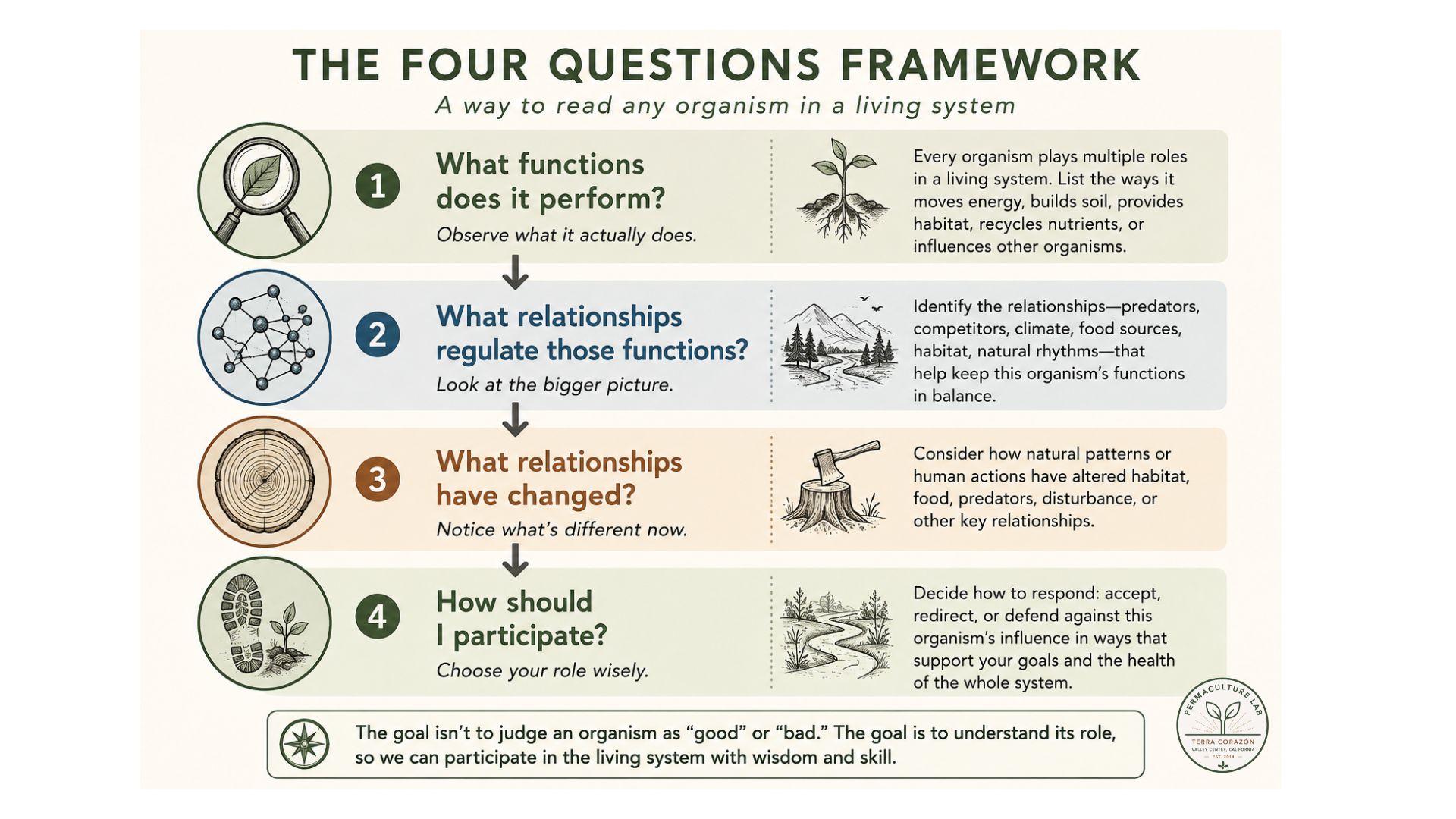
But before trying to eliminate any organism, I think it's worth asking four questions.
- What ecological functions does it perform?
- What relationships once regulated those functions?
- How have our own actions changed those relationships?
- How can we participate in ways that preserve beneficial functions while minimizing unwanted consequences?
Those questions seem far more useful than asking whether an organism is simply good or bad.
One last observation
The day I trapped the gopher that had been eating those plants, I buried it where I caught it, beneath one of our avocado trees. On one level, that sounds contradictory. I had interrupted one part of the nutrient cycle while immediately participating in another.
The gopher would still become soil. Its nutrients would still move through fungi, microbes, insects, roots, and eventually back into the landscape.
That small act reminded me that even when we choose to intervene, we're never standing outside the system. We're always participating in it.
Perhaps that's the deeper lesson. Restoration isn't simply solving problems. It's learning to understand the relationships that create them, and then choosing to participate in those relationships a little more wisely.